


Live Project Animation
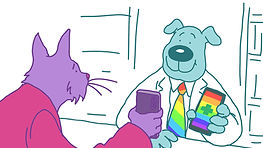
Shot 2: Approaching the desk

With shots assigned, I began working on shot 2, where the main character approaches the pharmacist's desk. I chose this to work on as it seemed like one of the most difficult pieces of animation to pull off successfully. Involving a walk cycle and subtle action, I thought it wouldn't be much fun for anyone else (unlike perhaps the flying shot or facial expressions).
I also wanted to challenge myself to perform an understated piece of action that felt convincing in weight and rhythm.
It has become an essential part of my process for animation to film myself for reference. Whether I stay close to the footage or not, it's a helpful way to get into character and find a sense of timing.
Here I was going for a shy, sheepish approach rather than a straight walk up to the desk. With a stuttering step and looking down at their phone, I hope to give the impression of a character thinking.
Rough first sketch:
Using one of my turnaround drawings for scale reference, I sketched out the walking action. Since being on the course, I have learnt to keyframe my animation to keep a consistent framework to the scene. In this case though, I just did a straight ahead run, to make it feel more spontaneous than a stable, continuous walk.
Naturally, I referred again to Richard Williams' basic walk cycle poses so I didn't get too lost on which drawing to do next.

Shot 7/8: Thanks, fly off...
When first putting our names down for shots to animate, I chose as my primary shots the one above (shot 2) and shot 7/8. These were two of the most difficult shots and so I thought it best to lead by taking on both, particularly as the compositions match and would be more consistent if animated by the same person.
I soon realised I had bitten off more than I could chew with the character animation I was already working on, not to mention the pharmacist frog which I will get to later. Maria had just finished with the backgrounds and offered to help out so I handed off the duties on shot 7/8. First though, I sketched out the keyframes below, as a rough guide for Maria to follow. I wanted this to help as a structure but with enough space in-between as not to limit the creativity of what Maria might naturally bring to the performance of the action.
Refining Shot 2
Now I can fully concentrate on this shot, I want to find convincing ways of making the body feel flexible, as it could easily come across as stiff and like a stick-man from this flat profile side.
I am trying to use intelligent shortcuts where I can. Instead of redrawing each frame, I have each body part on a separate layer and can move it bit by bit each time. This makes it easier to imagine how weight might take effect on different parts of the body at different rates. In many ways this is akin to puppetry, and may serve me well in other forms of digital animation with 'rigging' characters in After Effects/Maya.
It's truly exciting for me to start to implement the basic principles of animation such as anticipation, follow-through, and ease-in/ease-out, discovering just how effective these tricks can be. Even adding a bit of follow-through to the stalk on top of the hat helps to keep the whole piece feeling alive when the body is stationary.

Once I finished the character animation, I needed to export the figures as a PNG sequence and reassemble the scene on After Effects. I had been animating both scenes on a longer canvas, as the latter flying shot would have a camera shot moving to the left.
Additionally, I requested that Maria rework the line-work of the backgrounds. I felt the black lines distracted from the soft coloured lines of the main characters.
Frog animations
For shot 2, I needed to include the pharmacist frog behind the desk, but he also needed to appear on shot 7/8. I animated him in both cases, as I thought Maria could use the time to just concentrate on the butterfly taking off.
I considered more elaborate actions for the frog such as double-takes or scratching his face but in the end it seemed less was more. Staging is a priority throughout this project, as I need to consider what we should all clearly communicate. Too much simultaneous action in different parts of the frame can awkwardly pull focus, when the main character is where I want the viewer to look.

Final shot 7/8 compositing Maria's butterfly animation and my frog animation. I used a working TVPaint file from Maria to time my frog's reactions to.
Directing...
With my pitch being chosen, I was immediately the default lead on this project. It has been quite stressful to oversee the work of the group as well as my own. It is difficult to know sometimes how much direction to give when we're all students at different levels of ability/experience. I don't want to trample on anyone's confidence by offering too much criticism on the drawing quality, and inevitably there are issues of consistency across our shots.
On some issues I felt fine in giving a steer on how to improve shots, and it seemed everyone was happier to be given clear instructions than to be left to work completely independently. Despite much lack of confidence in myself, I do feel like I have it in me to be a director one day. I tend to instinctively know what is needed to drive everything forward and which battles to choose when deadlines are fast approaching. I hope I learn to trust myself through projects like this, and recognise how my oversight is a real asset to the project.
It really feels quite magical to see some of my drawings come to life by animators other than myself.
For instance, Ruby's expressive treatment of what was a single storyboard image. I didn't ask to add a reaction and 'ooh' from the frog as he sees the butterfly's phone, but these extra touches from Ruby really add a memorable spark. I took this as a cue for my own frog shot, adding another 'ooh' reaction.
Reacting to each other's shots was necessary to keep it feeling coherent. Often I have a clear picture in my mind of how I would realise a scene, and I forget that someone else could bring an entirely different, and better approach. I am appreciating how directing doesn't come from one dominant voice but should provide an environment for everyone to show off their strengths. Delegating can feel uncomfortable as I'm relinquishing some control, but if I'm working with the right people then it will be the only way to complete projects on a larger scale.
Communication
Any time I would make handwritten notes to myself, I would finish by reminding myself in giant letters, 'Communicate.' Nothing is necessarily self-evident, and unexpected problems could always arise simply because we're not on the same page.
We had a group chat on Instagram in case there were any issues to be discussed, but additionally I wrote up weekly Word documents to summarise what needed to be done in shot-by-shot breakdowns. Here I could be specific about each shot, addressing each group member's tasks, but also provide an overview for everyone to read so we were all aware of shared things to keep in mind.
I had to make sure were all all singing from the same hymnsheet when it came to choice of tools on TVPaint, line thickness, frame rate, and any other general thoughts as we went along. Regular updates have been essential, as some parts of the project were completed faster or slower than expected and new tasks needed to be assigned.

Anytime we were all in the studio I hope I was approachable and I was always available to confirm what was needed. The script for the voice-over, for example, was primarily Risha's job but I made sure we discussed it together.
Final crit
Still a work-in-progress at this stage, we needed to present our film to the client. Thankfully, the notes concerned minor corrections to the graphics page which we were already going to change, and adjustments to the audio.
I believe this was a reflection of our efforts to interpret what the client initially asked for, and our research in the early stages. It hasn't been an easy one to understand, as the app isn't currently available to download and reference directly. I think we found a good balance of simplifying the complex ideas and elevating the material with a charming, friendly animated introduction.
Shot 9
The original plan for this final scene was to have everyone involved in contributing a character - at one point I said I would finish the whole thing myself, then ultimately I had to call in everyone's help to complete it. As lead on the project, I took on the main character's action, and it took longer to finish than anticipated.
This is the rough preview featured in the final crit edit. I sometimes fell behind schedule on my animation shots as I was overseeing other issues that came up in the studio. Ruby's extra butterfly features here, imported into After Effects as PNG sequence and then moved around with automated animations.
Here's my completed animation for shot 9, with a new background I drew myself (hopefully matching the painterly texture of Maria's backgrounds). As with all of the other bugs to appear in this shot, I intended for additional floating movement on After Effects when the butterfly comes to a standstill.
The challenge here was to create a believable sense of momentum and weight when coming to a stop. I enjoy playing with these moments, and though I can see room for improvement, I like the sense of cushioning I have here. The wings were a struggle but I got it working eventually.
Often the lesson during this course seems to be 'is this good enough to move on?', when my natural instinct is to ask 'how can I improve this?'- usually leading to unfinished work when I have no immediate deadline.
Shot-by-shot
Shot 1. (Audy)
Not much direction from me. Audy would check in with me regularly enough for me to approve how it was going with the linework for instance. The poses of the butterfly arriving feel appropriately shy and hesitant. Going from this to my following shot, there is a bit of a disparity in pacing; it was hard to anticipate this or readjust.
Shot 2. (Joe)
Bridging two other shots, I wanted to make sure I was keeping the flow of action. I asked Audy to bring the butterfly to a standstill ahead of my shot. I kept my butterfly walking at the end of this shot, in reaction to Ruby's where the butterfly is still moving on arrival.
Shot 3. (Ruby)
Again, not much direction from me on this one. I like the sense of character Ruby brought to this interaction. I'm not sure what the right balance is of insisting on stylistic consistency. Clearly we're all still learning, and being able to adapt to all kinds of drawing styles is a big ask so early on. If I were working on my own production I might have pushed for another final polish on some shots.
Shot 4. (Ruby/Joe)
Ruby animated this, and again the sigh of relief shown in the shoulders conveys the character's emotion as intended. I added the phone on After Effects, tilting upwards and scaled up, alongside a camera move down to suggest the point of view of the pharmacist. I thought this was an organic way to transition into the app itself.
Shot 5. (Joe/Risha/Ruby)
A joint effort here. I took screenshots from the PRIDalLY website preview, and tried to simplify the graphics in a way that fit the visual style of everything else in the animation, using these soft-cornered rectangles and pond-life characters. Ruby helped to animate the talking head bugs, and Risha arranged everything on After Effects with retyped info.
Shot 6. (Risha)
I suggested the blurred-out background here, to emphasise the close-up by implying depth of field (as with Ruby's shot 4).
Shot 7/8. (Maria)
I was grateful that Maria was available to help out on this, it's a complicated shot. At least I was able to contribute the pharmacist frog and the initial key frames. Maria wanted to work on it though, as she said she would value having a walking/flying shot in her portfolio.
Shot 9. (Everyone)
I'm glad this came back around to the original plan of having everyone add something to this shot. I animated the main butterfly. Ruby, Risha and Audy (twice) animated the others -in Audy's case, one of his was designed by Maria. Maria also worked on the After Effects hovering animations. It's a fitting final image for a project ultimately well realised by the whole group.
Coming to a close
This is the final edit handed off to the client. I was involved at different stages of the editing, and the audio track was provided by Risha. Uncharacteristically for me, I wasn't at the computer for the final tweaks of the edit, though I was present in the studio with Risha and Maria.
I feel that it's an important step for me personally to step back from full control. Though there's a part of me screaming that I should have stayed up till midnight making last minute adjustments, I am glad that we had a moment to congratulate each other in person as a difficult project reached the finish line.
Keeping up morale has been on my mind throughout. I hoped to keep an atmosphere of being excited about what we're doing, unappealing as the brief might have seemed at the start. I want to carry that consideration forward and be less harsh on myself when it's a solo project too. Too often I pile undue pressure on myself, and though this comes from a place of wanting to do my best, I soon burn out from lack of sleep and breaks.
The mutual encouragement from all members of the group on this project has been a valuable reminder of the joys of making, and the imperfections need not get in the way of that overall feeling of accomplishment.