Lip Sync Project
Animating
Continued from previous blog:
First things first, I sketched out this rough animatic to fit an extended audio clip. The original clip was 10 seconds, and this extends to over 30, with ambient swamp sounds and sound effects to fit the action.
Given the time available it may be a bit difficult to finish the full scene, and I may have to complete the longer introduction shots later on.
Giving more space in-between the lines of dialogue gives a bit more license for comedic timing and implied thinking time for the slow-minded frog on the right. I enjoy playing with the performance in this way, and the choice of shots also helps to communicate the dynamic between them i.e. the shot where the middle frog is literally looking down on the bewildered frog.
Acting and accents

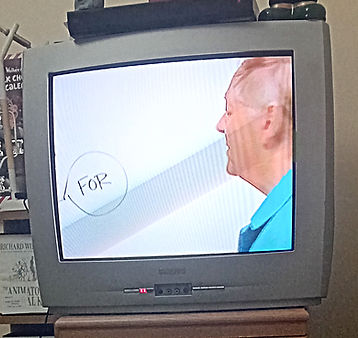
This was my setup at home, with drawing tablet and TVPaint, plus Richard Williams' instructional DVDs playing in the background.
I purchased a copy of Richard Williams' 16 DVD Animator's Survival Kit just before starting the course. It has been an invaluable part of my learning, breaking down intimidating tasks into something I can grasp. I have got in the habit of just sticking a DVD on even if it's not the exact lesson I'm addressing, as the general principles seem to always be relevant to any area of animation.
In this particular case, there are 2 DVD sessions on dialogue in animation, so I kept replaying them. This course paired with Williams' masterclass are rare experiences for me of properly learning from a teacher, as I have previously taught myself everything by imitating what I see rather than following direct instructions.
'Phrasing': here's one of the lessons that helped me to pay attention to which mouth shapes were strictly necessary. Williams demonstrates with the word 'hello' how the 'L' barely registers. My initial instinct might be to articulate every letter of the word, when in reality the face is skipping past certain parts. It depends on the soundtrack and characterisation, but these lessons show me I shouldn't assume anything about how we enunciate words (or don't).
I learned that Frank Thomas, one of the Disney greats, said that it's best to animate the character' expressions through body language first, and put the mouths on last. This is so that all the emotional cues are clear to the audience, and the dialogue is a final flourish to emphasise the point.
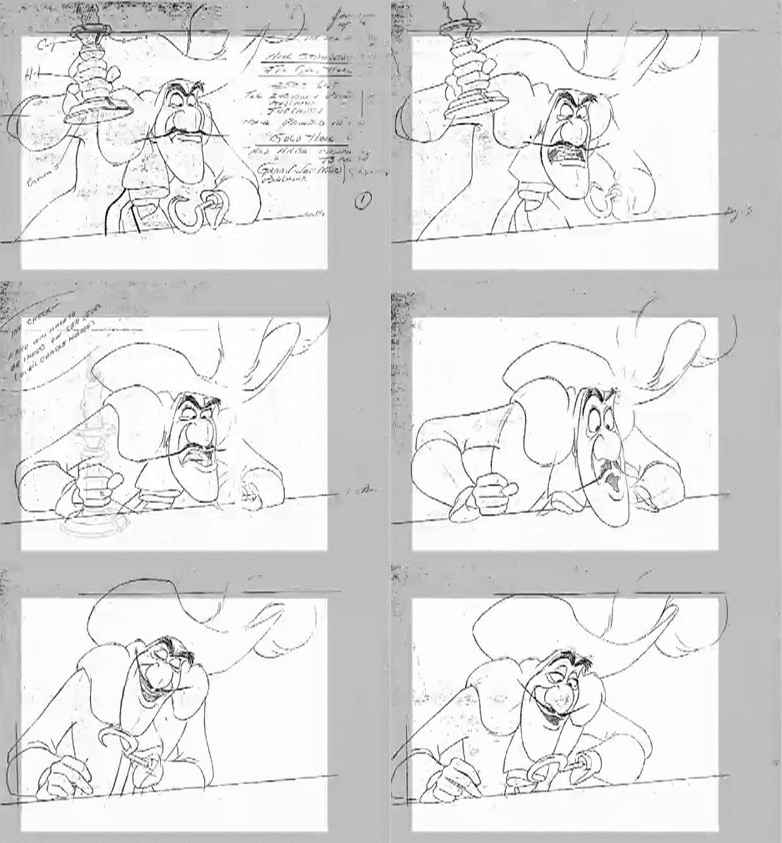
From this pencil test clip of Captain Hook, we can understand everything he is feeling without hearing the audio.
Filming myself
It can only help to have as much reference material for the performance as I can get. I took several videos of myself doing various takes of the lines of dialogue I will be using - these aren't the only takes (I'll spare you the full set).
I had to get over a lot of reservations I have about filming myself, for various reasons. It was nice though to rediscover a childlike sense of just messing around and using my face as a literal tool for expression.
The main takeaway I had was concentrating on the direction of my head movements, which I would struggle to imagine without acting them out. I also thought about which words in the sentence I would emphasise, giving me a steer on which moments to accent in the animation.
Williams draws attention to the genius of Jim Henson, whose puppetry perfectly conveys dialogue without the additional trickery of lip movement or animated eyes. The secret being the accents of the head and body, which tell us all we need to know about how the character is thinking. I have seen plenty of lifeless animation where the mouth is synced perfectly but there is no progression in the movement of the head. I want to have some sense of going somewhere when I'm animating my characters.
Mouth shapes and dopesheet

In preparation for syncing up the dialogue to the animation, I broke down the words phonetically and according to mouth shapes. It can easy to slip back into the conventions of the written word when certain letters are not actually emphasised or shown at all.
I came to understand that some letters are more open to interpretation i.e. 'D' and 'G', and I will need to look in the mirror to get a sense of how my mouth shape changes from syllable to syllable.
Below is the 'dopesheet' which lines up with the frames for the animation. It can be surprising how many frames a letter might span, or how few.

Here are some more sketchbook pages showing a series of face studies and mouth shapes for each frog.


I then learnt how to translate these mouth shapes into a set of reusable 'brushes' on TVPaint. These mouth shapes were useful to get an initial rough layer of lipsync, and then I made a fresh layer for each final piece of animation. The performance required a bit more attention than a simple series of mouth shapes. If anything, I ended up making the lip movements more smudgy, according to the characters involved - there can be mumbly quality for which over-enunciation doesn't ring true.

Shot by shot
I had to concentrate on the main lip sync shots to meet the deadline, leaving the scene-setting intro shots to complete if I am able to find the time over the Christmas break. Usually I strain to be ambitious and expect more of myself than I can realistically deliver. I'm starting to see this as a weakness rather than a virtue, and a more professional attitude would be to consistently meet more manageable goals.
1. 'What a beastly girl'
This is where I really realised how effective it is when the head is moving. I tried out the the lip sync without as much movement and it did feel unmotivated and not quite alive. Just a bit of a twist and accent of the head brings the whole performance to life, particularly when timed well with the audio.
2. 'Despicable!'
I like to get goofy, and the designs of the frogs were intended to allow for a bit of silliness in the animation. The drifting eyes and squashy face were fun to play with. The up and down bounce helps to give a glimpse of the three-dimensionality of the head, which can get lost in the flatness of 2D animation.
3. Staredown
I tested this with the background frog coming forward into view, but nothing quite worked as well as the still image. I did want some sense of movement in this shot though, so I took the PNG into After Effects and moved some cloud sketches around in the sky behind them.
4. 'You don't know what we're talking about...'
Again, the progression of the head movement made all the difference here, giving some flow to the action. This middle frog character was the most difficult to draw and animate because I wanted everything to be extra subtle. This does still look a bit jumpy to me, but I found that it needed to be halting in some places to feel true to human expression.
5. '... Dragonflies?'
I'm still not sure if this was the right answer, but there is very little movement here. I tried animating the frog on the left more i.e. head in hand cringing, but it just seemed like too much animation to me. I also tried 'boil' effects to give the static characters more life, but I just didn't like the look of it in this case.
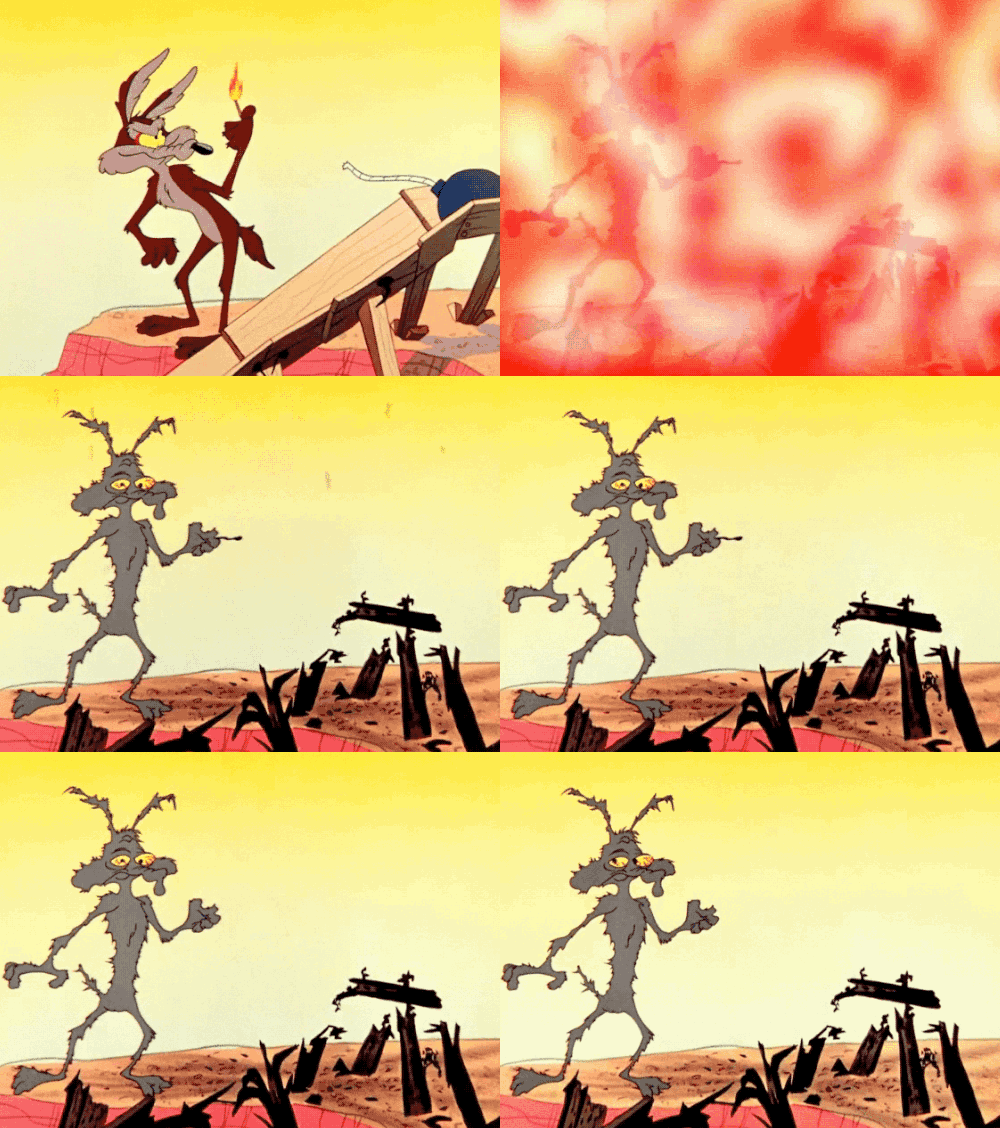
I always think of Chuck Jones' work on the Wile E Coyote cartoons when it comes to carefully placed limited animation. It's all in the timing and non-reactions, and I think that's found its way into my own approach.
Final thoughts
I have really enjoyed breaking down the performance aspects of this project. Typically I have thought of myself as a visual artist, but that ignores the huge part of me (often hidden) that loves acting and making people laugh.
I love animation but I have often wondered if I have the right temperament to be an animator. There is so much trial and error involved in getting this right, so getting it right tends to feel like a fluke. I have never been great at being philosophical about my work not going well, and I need to find some way to expect the frustration if I were to make animation a long-term career option. There's definitely a perfectionist streak in me that needs to go.
Something magic can happen even when the drawings are kind of sloppy, as if the motion itself is what holds it together. I have been thinking about some examples of animation where the imperfection has a charm, like the early seasons of The Simpsons. In my opinion, some human quality was lost when the animation became more slick over time, and yet I still pursue perfection in my own work.
If the story is working, the visuals probably don't matter as much anyway. It's very early days in my animation experience, and I just want to enjoy the discoveries I'm making instead of always seeing my limitations.