


Character Design


Just as a warm-up exercise, we started by drawing one of our own characters as a means of exploring shape language. I drew one of my comic strip characters, Captain Crotchet, whose adventures I would write and draw in lunchtimes at high school - it's good to see him again!
I have always designed characters in an instinctive way, so it's interesting to break down the subconscious effect of shapes in the design of the figure. Captain Crotchet (above left) has a rounded form, with circular motifs running through him, suggesting a friendlier personality. In fact, the way I drew him over time became even more doughy and soft, having started with a square jaw in his heyday. To see the effect of other approaches, I drew him with a square motif and then triangular. A blocky look shows stability and therefore self-assuredness, whereas triangle shapes can suggest an off-balance or suspicious demeanour.

Sketch of Captain Crotchet in action
With the graphic novel project coming, it feels good to briefly reconnect with an old friend in Captain Crotchet, reminding me of the joy of making comics.

Ahead of the graphic novel project, I am designing a character using random prompts. My selections were: Ancient Egypt (period/setting), scraggy (physical appearance) and cheeky (character trait).

These drawings are my initial assorted ideas fresh from mind-mapping.

One of my first character ideas was a living half-skeleton pharaoh, wise-cracking ('cheeky') and mystic. I enjoyed the surreal nature of this, imagining him in a 'Zoltar Speaks' kind of fortune-telling machine, though actually having lived centuries. The notion of a corpse in an upright box is a natural parallel to a sarcophagus and I love finding odd mash-ups. I soon realised it wouldn't work as part of the brief required walking on two legs, but some aspects of the character would stay in my mind going forward.

There's a freedom in these first meandering stages, inviting any and all ideas. Here I considered various animal characters as a means of playing with social hierarchy in a cartoony way.
The relationship with a pharaoh depicted here would later reappear in a different form with my final character. It's often the case for me that small, disposable ideas ultimately spark off a larger plot.

From the mindmap and initial doodles, it seemed an undead mummy fit all the prompts, and would be fun to draw!

Moodboard 1: Researching mummies and Ancient Egypt

Moodboard 2: Pop culture depictions of mummies/the undead
Something that fascinates me is the additional shorthand that evolves in our culture to recognise different ideas. Even when historically inaccurate, if we've seen an image reinforced again and again i.e. in Halloween costumes, in cartoons, music videos etc, then it's almost more relevant than a strictly realisitic depiction. Working in animation and illustration, it's exciting to have the freedom to stretch and play with what has come before, so I can ultimately add something new.
Observational sketches
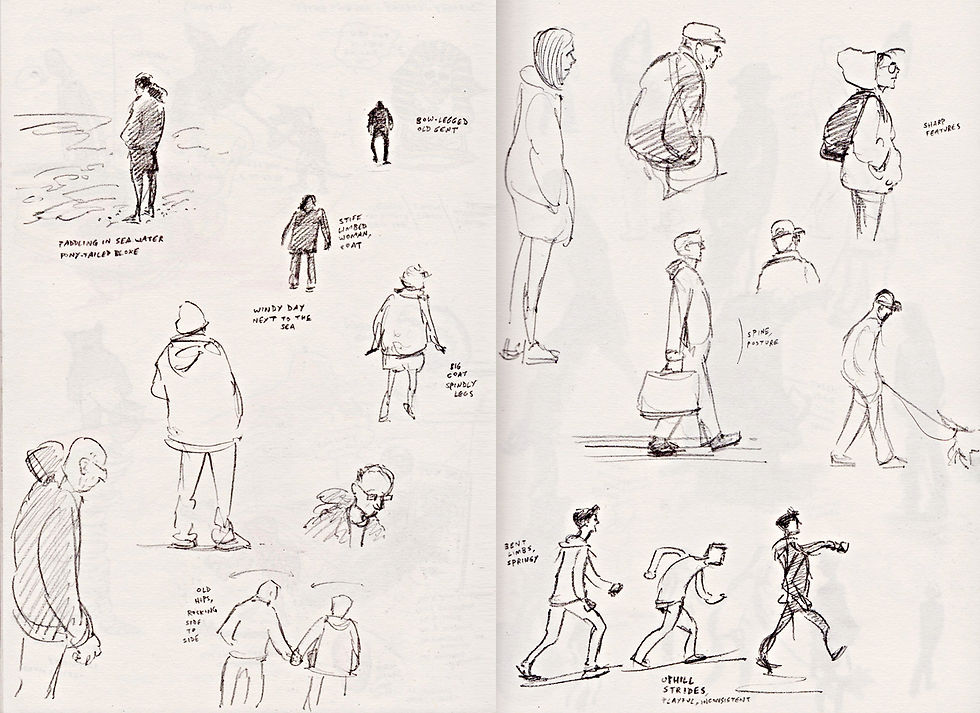


With the undead mummy as the broad idea going forward, I went sketching people from real life at my local seaside town of Felixstowe. I was seeking figures whose physical characteristics fit the 'scraggy' description, i.e. skinny and ideally bony. Also I kept an eye out for those whose movements struck me as somewhat awkward like a walking skeleton. Being on this animation course has led me to look for how people move as a shortcut for gestural drawing, giving a clue to the character beneath. I made a note of these observations as I went; it seemed everyone had a distinctive gait once I started looking.
I feel like recently I have been rediscovering the versatility of a simple graphite pencil. You can vary the pressure, soften or sharpen up the line, and most importantly for recording figures like this, you can observe and react very quickly. To mix it up a bit, I also tried quick painted figures using gouache and water. This could be surprisingly effective, as I could block out the whole figure in almost one stroke. Many of these sketches look quite basic but, as I have found in life drawing sessions, I find that I learn a lot from these fast gestural studies.


Pencil sketches from The Fitzwilliam museum collection in Cambridge, which has a few featured rooms on Ancient Egypt. This was still at a stage of not knowing for certain which direction my character would take, but it was useful to get immersed in Egyptian imagery and culture. I wanted to pay attention to any stylistic signatures of Egyptian art, with the likelihood I would apply a similar aesthetic to my character/story.
I noticed certain recurring design features like elongated figures and sharp angles. There's a stiff and stony nature to much of the surviving art, which I will also keep in mind when refining my own designs.
Additionally, I found value in sketching from non-Egyptian sculptures where I saw appropriate bony heads and figures. Giacometti's 'The Egyptian Woman', for example, is not originally from Egypt but helped me to think more about style and how to emphasise the angles of the face.
Character sketchbook

Silhouettes are a great test of seeing if a character is distinctive enough - if they can be recognised in the dark then it's probably a stronger design. Here the exercise pushed me to pay attention to posture and skeletal features. I wanted to find which details would really signify the depiction of a mummy, so I twisted and distorted, testing to the point of absurdity. Working in thumbnails really helps to exaggerate the whole figure - when I'm working on a larger sketch I can get too concerned with details to notice how unremarkable the body is.

Next I made this set of small varied designs, with the simple goal of getting as many different kinds of distinct characters as possible. There are bits and pieces from this page that would be combined into the final design. I tend to draw characters either doing something or showing a particular expression, as that seems to feed into the pose and therefore the type of figure. Many of my sillier sketches are perhaps best realised as singular gags, but certain elements can be expanded upon.
Some features that would be carried into the final version:
- Bottom right: the head of this mummy felt a bit more original than the usual fully-covered face often seen in mummy characters.
-Top left: the general awkwardness of the twisted body and hanging bandages felt right, but I needed more rigidity in the limbs.
-Top middle: the sense of a magic spell or curse, in the vivid green around his head, would reappear in the glowing eyes of the later design.
The silhouettes would also have a particular impact on the final design, in further slimming down the figure, and introducing a more angular flatness inspired by Egyptian art.

Refining the design
As I continue to work towards a final character, I am also writing down initial story ideas, which feed into the personality of the mummy. Here is a first page of exploratory thoughts, about his presence in the modern day world and looking back to possible past lives in Ancient Egypt.

In the following pages, I am settling on a finished design and testing how he would stand and move in the context of the story going forward.


Here I am taking the idea of body parts falling off to an extreme. I find it useful to test where the right balance is by going too far.
At this point I am fully embracing the jester idea and assigning a name: Zub.
Zub would have been an irreverent jester in his life in Ancient Egypt, performing as 'The Living Mummy' long before he was actually mummified. This joker attitude reappears in his natural responses to his new undead life; despite its physical difficulties he is not blind to the comic absurdity of it all.

Finally, in preparation for the turnaround, I made a clay head for reference from all angles. I'm sure for future projects I will find it useful to do the same with a whole figure.
It is clear to me that there is inadvertently something of a superhero influence in the design, similar to a mask. Although it's not a typical treatment of a character from the horror genre, I hope it feels fresh. I find it useful to draw influences from unrelated genres, so I don't get stuck in clichés.


Turnaround and Portrait


This character turnaround brings together my favourite elements of the sketches. Working out ideas in silhouette helped me here to make the poses consistent, and ensured I was communicating the physicality clearly. Previous thumbnail silhouettes emphasised to me the importance of a distinct shape to give an instant read.
I wanted to incorporate an Egyptian influence in the angularity of the figure, suggesting something of the ancient 2-D/relief murals. I was going for a comical flatness to the design, as if he's been squashed between stone slabs and stuck in a tight box for thousands of years. Also I rounded all corners to soften the effect; despite the potentially sinister zombie appearance, I want him to feel harmless and sympathetic.
Getting a consistent turnaround was difficult. I want to be expressive but I struggle to replicate the vitality of a one-off sketch. Each pose has to be very precise in how it relates to the others. Any kind of asymmetry in the pose gives an extra level of challenge, and here it felt necessary to twist the body to convey the mummy's fragility. It's a test of my perfectionism just to move on to other work since I can still see details to improve on.
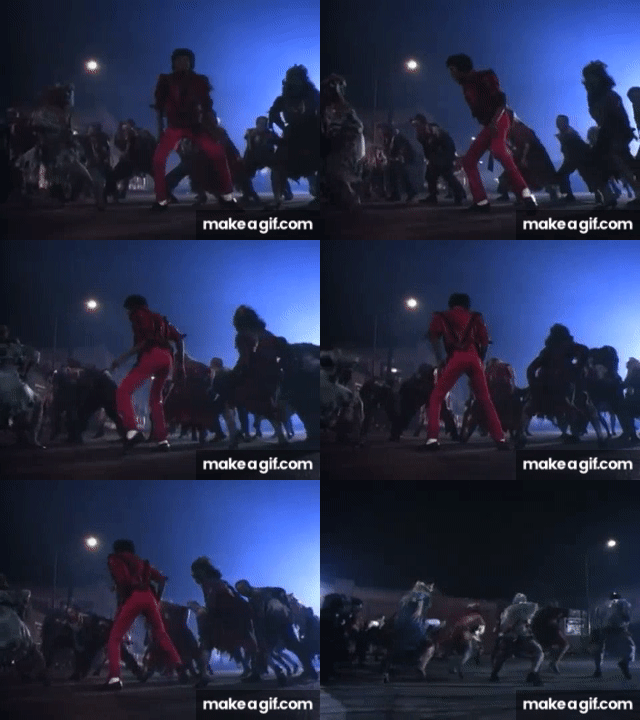
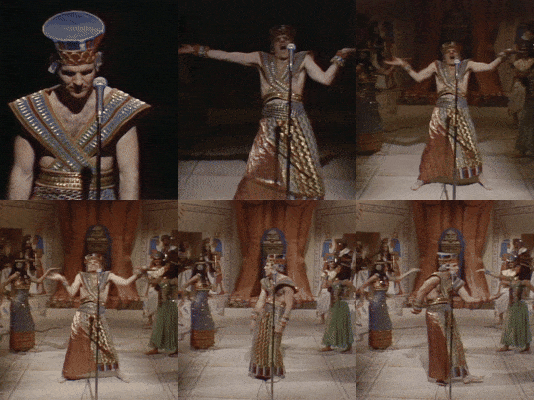
Although the turnaround is a set of still images, I was also thinking about how Zub would move, or rather how he would struggle. Certain influences pop up in my mind as I work, like Michael Jackson's famous Thriller dance, from which I imagined the mummy pivoting on one dead leg. Also here's Steve Martin performing King Tut, with a spirit of silliness I don't want to drift too far from.
Continued on next blog:


Much more story development, and designs for the pharaoh on the next blog.